


How AI makes ‘great’ the new average

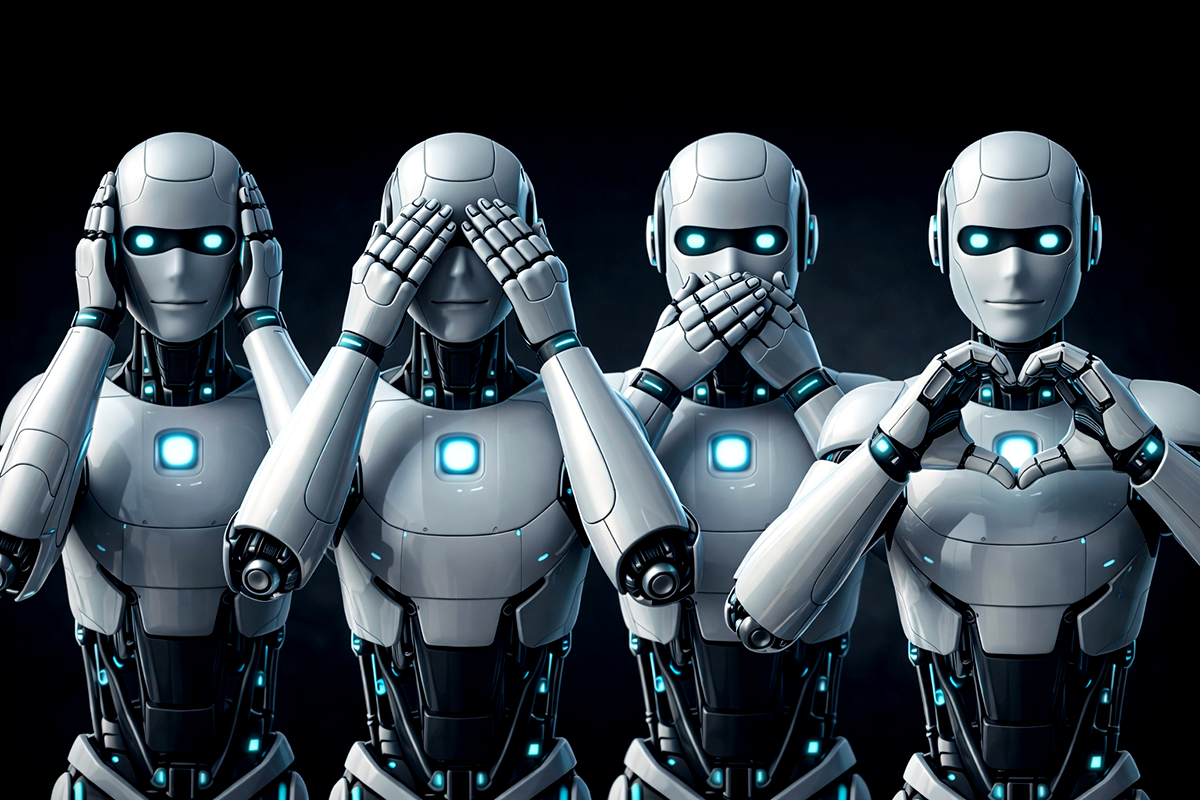
Hear no evil. See no evil. Speak no evil.
Every technological shift begins with a moment of wonder: the first light bulb, the first photograph, the first website. Moments where possibility briefly feels limitless,and right now, AI sits squarely in that space.
What makes this moment both exhilarating and humbling is that we are not witnessing its peak, but its adolescence. We are still at the edge of what it can become. And if this is what “early” looks like, it’s worth pausing to imagine what maturity will bring.
Soon, what feels powerful today may look primitive in hindsight , and much sooner than we expect. That’s the nature of exponential change: it redefines our baseline. So when I hear people say, “AI is the end of creativity,” it feels misplaced. Thisisn’t the end, it isn’t even the middle, it’s just the beginning.
The current dominant narrative often reduces AI to a set of blunt fears: AI is bad. AI will take our jobs. AI will replace humans. This framing feels overly simplistic and reminds one of a “four legs good, two legs bad” kind of binary and Orwellian shorthand for something far more nuanced.
AI is not a single outcome or ideology, it’s not inherently good or bad . It’s a tool and like every transformative technology before it, its impact will be shaped less by what it is, and more by how we choose to use it.
It changes the conversation from “what is AI doing to us?” to “what are we doing with AI?”
And that brings us to an old idea that feels newly relevant:
“Hear no evil. See no evil. Speak no evil.”
Today, we often interpret this saying as passive: turning a blind eye, staying silent, opting out of wrongdoing.
But its original 17th-century Japanese meaning was far more active: a call to discipline,awareness, and moral intent. A reminder to consciously guard what we consume, what we amplify, and what we put back into the world.
Reframed for this moment, it therefore becomes something more powerful:
- Hear no evil: Be critical of the data, narratives, and biases we absorb and train into systems
- See no evil: Be aware of the consequences of what we build and deploy
- Speak no evil: Take responsibility for what we generate, share, and scale with AI
Because in an age where technology can amplify anything, inaction is not neutral and to ignore misuse is, in its own way, to enable it.
And there’s a fourth principle we need to make explicit: Do no evil. Not as a slogan, but asa standard, conscious choice to use AI as a force for creativity, progress, and human good.
The risk today isn’t that AI will run wild it’s that we’ll stop running at all. The enemy is the ease of AI.
The New Baseline
Let’s be honest, AI can think and problem-solve exponentially faster than us, and now writes better than most people. With the right tools and using the premium paid-for versions, AI can design, create, edit, composite, slice and dice at high speed and with good enough approximation.
In our sector scripts are generated in seconds, campaign visuals in minutes, edits are automated, voices cloned and ideas remixed at scale. AI has already changed the creative landscape. That much is undeniable.
Which means something profound is happening in creative industries, particularly in marketing, advertising, social media, film and video. What used to be considered great (polished, engaging, persuasive,cinematic, smart) is now achievable with minimal effort.
And that is how AI has made ‘great’ the new average, meaning when ‘great’ becomes average and everyday, great stops being special. The barrier to entry has fallen and the barrier to meaning has risen. Over-reliance on AI content can flatten things.
Yes, AI can produce things you didn’t explicitly think of, it can surprise you because it can connect dots faster than you ever could. But it doesn’t care.
AI doesn’t know why something should exist and it doesn’t understand consequence. Humans still decide what’s worth saying. And in a world where everyone cangenerate something “great-looking,”
the differentiator is no longer execution. AI standardises output.
So, in conclusion, now is not the time to switch off our judgement and be lazy about what we create, particularly in video production.
Now is the time to sharpen it! The evil or danger isn’t AI itself; it’s outsourcing common sense, judgement and intention.
Right now, across creative and marketing sectors, there’s a quiet recalibration happening. Brands are realising speed isn’t strategy, creative agencies are discovering prompts aren’t positioning and creators are coming to understand that automation isn’t authorship.
So the question shifts. If AI can make it great…what makes it meaningful?
Related Articles



zoomfilms
AGENCY

